Standish by Erastes
Lethe Press, 2013
Historical settings have long been popular in the erotica and erotic romance genres. There are many potential advantages to using the Victorian era, the Regency period, medieval France or ancient Rome as the site for a sexy tale. Plot, character, and setting elements that would be difficult to justify in a contemporary story fit naturally in the past: corporal punishment, kidnapping, and slavery; ruined gentlewomen and debauched nobles; exotic costumes and accessible undergarments; romantically isolated castles and conveniently private carriages; candlelight instead of electricity; hand-penned missives, scented and wax-sealed, in lieu of email.
Many "historical" erotic novels, however, merely adopt the trappings of their chosen period while retaining a modern perspective. The attitudes and actions of the characters are not consistent with the mores and assumptions of the historical period. Even the language is frequently contemporary, using modern conventions that eschew description and favor a third person limited-omniscient point of view, focused on one or two characters.
Standish, a homoerotic romance set in England in the Regency period (roughly 1800-1830), is the real thing, a genuine historical novel in which the characters are believable creatures of their era. In Regency England, buggery was a capital crime and duelling was an accepted method for settling disputes. Society was divided between a wealthy aristocracy renowned for its excesses, and a rabble of poor, uneducated commoners who lived in unbelievable squalor and misery. A fledgling middle class struggled to emulate the respectability and extravagance of the nobles. Position and reputation were supremely important. The world was a dangerous and uncertain place as Europe looked back fearfully on the bloody years of the French Revolution.
Standish is set against this background. It chronicles the relationship of Ambrose Standish, a bookish, sheltered former aristocrat fallen on difficult times, and Rafe Goshawk, wealthy, cynical, and highly susceptible to beautiful young men.
From the very first, Ambrose and Rafe are in implicit conflict over Standish, the elegant Dorset estate that should have been Ambrose's birthright. Rafe's grandfather won the estate from Ambrose's grandfather in a reputedly rigged card game; the elder Standish was later killed in a duel when he accused his opponent of cheating. Ambrose lives with his spinster sisters in a modest dwelling on the fringes of the Standish property, the main house always before him like an unachievable dream.
After living abroad or in London most of his life, Rafe decides to move to Standish with his young son Sebastien. Unaware of Ambrose's family history, Rafe hires Ambrose as a tutor. As soon as the worldly aristocrat sets eyes on the handsome young scholar, Rafe desires him, although Ambrose is cold and formal. Rafe's schemes of seduction are derailed when he suffers a serious fall and is bedridden for several weeks. Ambrose cares for the invalid Rafe, and gradually falls in love with him. Eventually Rafe recovers and realizes that Ambrose is more than simply a conquest, that he loves the man and that his passion is returned.
All this happens in the first dozen chapters. The novel continues in the typical mold of a romance, with obstacles and misunderstandings arising between the lovers, which at long last are resolved. The obstacles, however, are far from typical. Just as he is learning to enjoy the physical aspects of loving Rafe, Ambrose is brutally raped by one of Rafe's discarded paramours. This sets off a chain of events that culminates in Ambrose narrowly escaping the gallows for buggery and being imprisoned in the notorious Newgate. On one level, Standish is a classic romance. Rafe and Ambrose are truly and deeply in love; this is a conjunction of souls, not merely a physical dalliance. At the same time, it turns romance conventions on their heads. In this period, Rafe and Ambrose risk their lives if they love openly. Homosexual desire is a mortal sin; homosexual activity is a crime punishable by death.
The historical authenticity of this novel is enhanced by Erastes' stylistic choices. She writes in the third person omniscient, with extensive descriptions and passages of bridging narration or backstory that would be out of place in a contemporary novel, but which fit the current tale perfectly. Erastes is not Jane Austen, but I could almost believe that this book had been written in the period that it describes.
The minor characters add to the effect. The clergyman dedicated to educating slum children; his gentle and self-sacrificing sister; the dissolute soldier who is ruined by his infatuation with Rafe; the scheming Irish prisoner who controls the Newgate occupants through bribes, threats and carnal favors; these characters are familiar figures from stories of the period.
The one aspect of the book that is likely not historically authentic is the sexual description. The sex scenes are much more graphic than anything one would be likely to find in a mainstream Regency novel, though they are less explicit than what one finds in contemporary gay erotica. Erastes doesn't mince words, but Rafe's and Ambrose's encounters tend to be sensual and intense rather than crude and raunchy.
I read a lot of erotica. For me, Standish was refreshingly different from the froth of recreational sex or the edgy post-modernism that characterize much of what I read. It is a well-executed period piece with stimulating characters and a surprisingly unpredictable plot. Even though I knew that this was a romance novel that should end happily ever after, I wondered up until the very end whether Rafe and Ambrose really would manage to be reunited.
If you are the sort of person who gets impatient with description and annoyed with an author that tells a story rather than focusing solely on the action, you probably should skip Standish. On the other hand, if you sometimes prefer the more leisurely pace of nineteenth century novels, and you're interested in gay male themes, then you will probably enjoy this book as much as I did.
Showing posts with label Standish. Show all posts
Showing posts with label Standish. Show all posts
Tuesday, January 20, 2015


Tuesday, April 27, 2010
Review: Standish by Erastes
Reviewed by Lisabet Sarai
(You can buy Standish at Amazon.com.)
Historical settings have long been popular in the erotica genre. There are many potential advantages to using the Victorian era, the Regency period, medieval France or ancient Rome as the site for a sexy tale. Plot, character, and setting elements that would be difficult to justify in a contemporary story fit naturally in the past: corporal punishment, kidnapping, and slavery; ruined gentlewomen and debauched nobles; exotic costumes and accessible undergarments; romantically isolated castles and conveniently private carriages; candlelight instead of electricity; hand-penned missives, scented and wax-sealed, in lieu of email.
Many "historical" erotic novels, however, merely adopt the trappings of their chosen period while retaining a modern perspective. The attitudes and actions of the characters are not consistent with the mores and assumptions of the historical period. Even the language is frequently contemporary, using modern conventions that eschew description and favor a third person limited-omniscient point of view, focused on one or two characters.
STANDISH, a homoerotic romance set in England in the Regency period (roughly 1800-1830), is the real thing, a genuine historical novel in which the characters are believable creatures of their era. In Regency England, buggery was a capital crime and duelling was an accepted method for settling disputes. Society was divided between a wealthy aristocracy renowned for its excesses, and a rabble of poor, uneducated commoners who lived in unbelievable squalor and misery. A fledgling middle class struggled to emulate the respectability and extravagance of the nobles. Position and reputation were supremely important. The world was a dangerous and uncertain place as Europe looked back fearfully on the bloody years of the French Revolution.
STANDISH is set against this background. It chronicles the relationship of Ambrose Standish, a bookish, sheltered former aristocrat fallen on difficult times, and Rafe Goshawk, wealthy, cynical, and highly susceptible to beautiful young men.
From the very first, Ambrose and Rafe are in implicit conflict over Standish, the elegant Dorset estate that should have been Ambrose's birthright. Rafe's grandfather won the estate from Ambrose's grandfather in a reputedly rigged card game; the elder Standish was later killed in a duel when he accused his opponent of cheating. Ambrose lives with his spinster sisters in a modest dwelling on the fringes of the Standish property, the main house always before him like an unachievable dream.
After living abroad or in London most of his life, Rafe decides to move to Standish with his young son Sebastien. Unaware of Ambrose's family history, Rafe hires Ambrose as a tutor. As soon as the worldly aristocrat sets eyes on the handsome young scholar, Rafe desires him, although Ambrose is cold and formal. Rafe's schemes of seduction are derailed when he suffers a serious fall and is bedridden for several weeks. Ambrose cares for the invalid Rafe, and gradually falls in love with him. Eventually Rafe recovers and realizes that Ambrose is more than simply a conquest, that he loves the man and that his passion is returned.
All this happens in the first dozen chapters. The novel continues in the typical mold of a romance, with obstacles and misunderstandings arising between the lovers, which at long last are resolved. The obstacles, however, are far from typical. Just as he is learning to enjoy the physical aspects of loving Rafe, Ambrose is brutally raped by one of Rafe's discarded paramours. This sets off a chain of events that culminates in Ambrose narrowly escaping the gallows for buggery and being imprisoned in the notorious Newgate.
On one level, STANDISH is a classic romance. Rafe and Ambrose are truly and deeply in love; this is a conjunction of souls, not merely a physical dalliance. At the same time, it turns romance conventions on their heads. In this period, Rafe and Ambrose risk their lives if they love openly. Homosexual desire is a mortal sin; homosexual activity is a crime punishable by death.
The historical authenticity of this novel is enhanced by Erastes' stylistic choices. The author writes in the third person omniscient, with extensive descriptions and passages of bridging narration or backstory that would be out of place in a contemporary novel, but which fit the current tale perfectly. Erastes is not Jane Austen, but I could almost believe that this book had been written in the period that it describes.
The minor characters add to the effect. The clergyman dedicated to educating slum children; his gentle and self-sacrificing sister; the dissolute soldier who is ruined by his infatuation with Rafe; the scheming Irish prisoner who controls the Newgate occupants through bribes, threats and carnal favors; these characters are familiar figures from stories of the period.
The one aspect of STANDISH that is likely not historically authentic is the sexual description. The sex scenes are much more graphic than anything one would be likely to find in a mainstream Regency novel, though they are less explicit than what one finds in contemporary gay erotica. Erastes doesn't mince words, but Rafe's and Ambrose's encounters tend to be sensual and intense rather than crude and raunchy.
I read a lot of erotica. For me, STANDISH was refreshingly different from the froth of recreational sex or the edgy post-modernism that characterize much of what I read. It is a well-executed period piece with stimulating characters and a surprisingly unpredictable plot. Even though I knew that this was a romance novel that should end happily ever after, I wondered up until the very end whether Rafe and Ambrose really would manage to be reunited.
If you are the sort of person who gets impatient with description and annoyed with an author that tells a story rather than focusing solely on the action, you probably should skip STANDISH. On the other hand, if you sometimes prefer the more leisurely pace of nineteenth century novels, and you're interested in gay male themes, then you will probably enjoy STANDISH as much as I did.
Saturday, December 26, 2009
Location, Location
By Erastes (Guest Author)

Thank you, Lisabet for giving me a space to blog today. I hope you all had a good day yesterday, whatever you celebrate or believe and my best wishes for 2010!
I'd like to talk about locations today, and why, to me, they are every bit as important in my books as the characters. Ruth Sims once said, about my first novel, "Standish":
One of the characters in Standish does nothing--doesn't move, doesn't speak, doesn't think. And yet this character controls emotions and actions and passions just by existing. It is a house called Standish. Like the Rochester mansion in "Jane Eyre" or the cliffs in "Wuthering Heights" Standish is a place so important to the story that it almost takes on life.I'm very happy that Ruth saw this in the book, because really, the book was just as much about the house as it was a love story between two men.
Standish as depicted on the cover of the book is an actual place -- a ruin as you can see, by the tree growing on the roof! It burned down in the 1930's -- but still an imposing and beautiful house. Witley Court in Worcestershire is no more than a shell, but the façade was so gorgeous that I fell in love with it and wanted it to be "Standish."
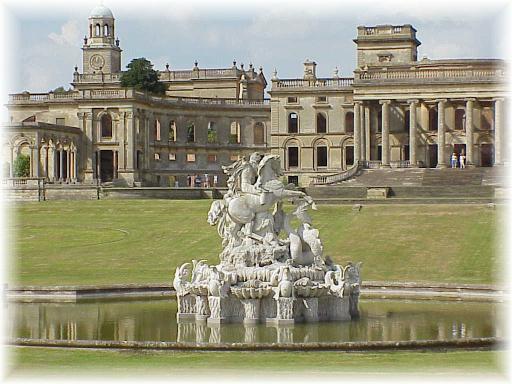
Unless I can find a place that I can really associate with, I find it difficult to write. The novel I've just finished, Mere Mortals, a Victorian Gothic set on the Norfolk Broads, is actually set in a fictional location--an island that does not exist called "Bittern's Reach"--but the Broad that the island is located in does exist, and that's Horsey Mere. I was originally going to set the story on Dartmoor, but I felt that Dartmoor had been done to death with mystery stories and if I wanted a mysterious and isolated location, one where it was going to be difficult for my poor protagonists to leave, I couldn't do better than using the landscape of the Norfolk Broads, which is on my doorstep--and much easier to research!

The house on the island, while important, doesn't hold the same iconic status as Standish - it's based on this house--Oxburgh Hall. But I needed something imposing with priests holes, and something inaccessible. Oxburgh Hall is entirely moated, so it was easy to bung it on an island and make it impossible for my protagonists to escape from.
mwahahahaha!!!

I know that many writing pundits say that one shouldn't start a book with description, 

Finally, there's no easier conflict than setting your story in a war. I'd always wanted to do a book about the English Civil War, as there are woefully few novels set in this period, and only one other gay novel that I know of, As Meat Loves Salt by Maria McAnn. I chose the setting for the beginning of Transgressions to be the village where the first major battle of the war was held. The village: Kineton. The battle. Edgehill.
What I found fascinating was that contemporary reports of the day tell of the local people coming from miles around to watch the battle, and this is at the same time unbelievable, and yet totally understandable. These were people who had not known of a conflict on English soil for hundreds of years. The battle took a good while to stage--the armies had to be marched into position, passing through towns and villages before choosing a location to fight--and so like a circus passing through town--it created a lot of interest. Everyone would have known about it and human nature being what it is it was natural there would be curiosity. Families made a day trip of it, packing picnics and spending the day on the view points around the valley. I doubt very much they knew what they were about to see. I can only imagine how horrific the sight of men and horses being blown apart by cannon could be, and I tried to instil this into the chapter where David and Jonathan sneak off after church on 23rd October 1642 and watch the bloody scene.
I visited both Edgehill and Kineton while researching for Transgressions and found both places almost untouched by time. There's an ugly and unprepossessing monument at the battle site but other than that, when you look down onto the river plain, it's hard to believe that anything happened here.
And that's what I love about historical fiction, is that you can touch these places and bring their hidden pasts, back to life. So many things have been lost and forgotten. When I visited Mistley to research the Witchfinder section of Transgressions, I visited The Thorn, the pub where the infamous Matthew Hopkins, self proclaimed Witchfinder General, had his base of operations and was desperately disappointed.


Any mention of Mistley's infamous resident has been expunged from The Thorn, and now it's just another gastro-pub/restaurant. Diners who sit down to their char-grilled rosemary brochette of chicken liver & smoked streaky bacon on homemade sourdough toast have no idea of the murky history of the area.
Which is a shame, I think!
What am I working on now? Another book where location is part of the story. It's a novella set in Lombardy, northern Italy, in the latter years of the peace between the
So that's me--hope you enjoyed a mini-tour through my mind and why I have to feel "grounded" with a sense of place, just as much as I must know who my protagonists are.
What's your favourite location for a novel? Does place matter to you?
Subscribe to:
Posts (Atom)