Showing posts with label spirituality. Show all posts

Wednesday, September 11, 2019

Books I Keep Meaning to Read - #BlogHop #Spirituality #Controversy #Islam


Blogging Challenge Banner

Instead of doing the MFRW Hooks blog hop, I decided this week to participate in Long and Short Reviews weekly blogging challenge. The topic for this week is “Books I keep meaning to read (but haven’t)”.

I knew immediately what book I wanted to write about, but I didn’t know if I dared, particularly given the date (September 11th). I finally decided that if I get trolled, spammed or hate-bombed, that says a lot more about the people reacting than it does about me.

You see, the book I keep meaning to read is the Koran.

I was brought up Jewish, but my spirituality has always been eclectic. I’ve been subject to influences ranging from Roman Catholicism to Hinduism. I don’t follow any organized religious tradition, but I am convinced that our existence has a spiritual dimension, that this spiritual dimension represents fundamental Truth or Reality and that our material world arises from and reflects this Reality. I also believe that the essence of Spirit is love or compassion, and that we are all connected, all drops in the ocean of Spirit.

Many evils have been perpetrated in the name of organized religion. Millions have suffered, not only the perceived opponents of these religions but also their fervent adherents. For me, that doesn’t invalidate the basic human search for some sort of transcendent truth.

There are those who maintain that the material world is all there is, that God is a delusion humans create for themselves in order to deal with a meaningless universe. I am not among those people; my personal experiences have convinced me that Spirit is real – maybe all that is real. I think every religion tries to capture this same basic realization and to communicate it in a way that matches the psyche and culture of its followers. Looked at another way, all Gods are one God – though my own view doesn’t necessarily consider Spirit as a supreme being.

In any case—I’ve read scriptures from many religions. However, I’ve never read more than a verse or two from the Koran, with no context provided. All I have is hearsay. Some people claim that the Koran encourages jihad and suicide bombers. Others claim that Islam is a religion of peace. Some people use the Koran to justify abuse of and discrimination against women. Others argue that this is a misinterpretation, an excuse to prop up a patriarchal society that existed before Islam was founded.

I really need to find out for myself. I think this is important, at least partly because Islam is so vilified these days in many Western countries. When someone tells me that the Koran says such and such, I want to be able to respond with some authority.


Of course, what I will probably find, if I ever do read this book, is that there’s some support for every interpretation. Even with a novel, readers will often disagree on the meaning, the author’s intent, even the details of the plot. Religious scriptures are far more complex and more ambiguous. There are many stories in the Bible, supposedly the fundamental authority for Judeo-Christian beliefs, that really give one pause. I could (but won’t) cite many Biblical stories in which God, or someone chosen by God, behaves in ways that are hardly consistent with compassion or truth.

There are many answers to this conundrum. Scriptures are transcribed by people (whether or not you believe they’re divinely inspired). They tend to be ancient, and to have been translated and adapted again and again, for different languages, societies and time periods. (In that sense, the Koran one would read today is probably closer to the original, since it has mostly been preserved in the original Arabic.)

In any case, the Koran is on my TBR list, though I do wonder how well an English translation would capture its essence. Unfortunately, I worry that if I were to buy a copy in today’s society, I might be opening myself up to all sorts of trouble – surveillance, persecution, maybe even violence. I wouldn’t download it from an Islamic site, either, for similar reasons.

Maybe it’s available at Project Gutenberg, where you don’t have to identify yourself.

Eighteen years ago today, a group of men supposedly inspired by the Koran perpetrated the deadliest terrorist attack in human history. I can’t begin to understand their motivations; it’s just too foreign to my world view.

It is hard to believe in a benevolent Spirit of compassion when faced with such atrocities.

I will, however, continue to try. 

Visit the other authors taking today's challenge:


Saturday, August 17, 2019

From a Distance - #Retrospection #Spirituality #Compassion


From a distance you look like my friend
Even though we are at war
From a distance I just cannot comprehend
What all this fighting’s for....
~ Bette Midler, “From a Distance”

Just before I entered my senior year in high school, humans walked on the moon for the first time. With my long-time love of both science and science fiction, I was jubilant. The stars beckoned. Anything was possible.

Only months later, the Ohio National Guard fatally shot four Kent State University students protesting the Vietnam war.

Looking back, I cannot recall how I reconciled the elation and the horror stemming from these two events, though I know both affected me deeply.

We believed, back then, in the inevitable revolution. Things would never be the same. “The time’s they are a-changing,” Dylan sang, and we believed. We looked to a new world of love and peace, freedom and justice and moral responsibility. The Age of Aquarius.

Things didn’t quite turn out that way.

Well, the times did change. They always do. We impeached a president. We waited in long lines for rationed gas. We danced to Saturday Night Fever. We watched the stock market crash, rise and crash again.

Hijacked planes toppled the twin towers and claimed three thousand lives. Nightmare waves scoured the coasts of the Indian Ocean, killing two hundred thousand. Having finally quit the jungles of Vietnam, U.S. soldiers occupied the deserts of Iraq and Afghanistan.

We elected a black man to the Oval Office—twice. We cloned sheep, transplanted hearts, sequenced our own DNA and that of our animal cousins. We haven’t walked on Mars yet, but our robots have. We know there’s certainly water on the Red Planet, and probably some form of life.

My siblings had kids, who grew up, graduated high school, went to college. My parents left the earth, after bountiful lives no one could call short. A dear friend succumbed to ovarian cancer at fifty two. Two of my former lovers committed suicide.

Technology followed the science fiction of my youth. Computers shrank to the size of match boxes. It became more and more difficult to distinguish fact from deliberate fabrication.

My spirituality is eclectic, but I do believe the Buddha’s teaching that everything is transient. Suffering derives from attachment, the attempt to resist changing circumstances.

Through the distance of six and a half decades, I find comfort in the constant cycles of change. No matter how horrible things appear right now, they’ll be different tomorrow, or next week, or next year. Of course this also means more hard times may be coming, but they will eventually fade away as well.

The only reality (again according to the Buddha), the key to breaking the chains of illusion, is compassion. That’s my focus now, in these latter days of my life. I am trying to release the hate and anger stirred up so effectively by today’s media. I don’t want to sweat the small stuff, but to do justice and love kindness and refrain from judgment if I can. I am trying, with mixed success, to be a center of peace, radiating to those around me.

Really, that seems to be the only option.

To quote Paul McCartney, another prophet from my youth:

And in the end
the love you take
is equal to the love
you make.


Friday, March 9, 2018

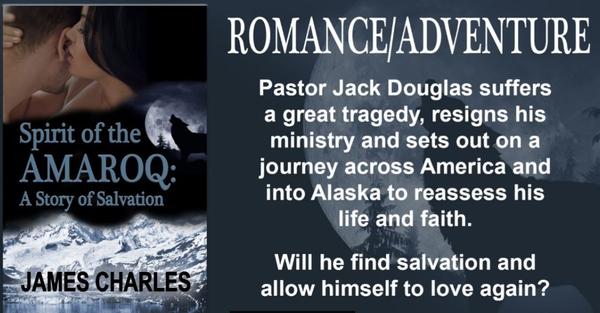
Spirit of the Amaroq - #NativeAmerican #Alaska #Adventure #Salvation @JCharlesBooks

Spirit of the Amaroq cover
Blurb

Pastor Jack Douglas resigns his ministry after a traumatic event and hikes across America. In North Dakota, he finds work on an oil rig until a violent turn of events forces him to seek seclusion in the Alaskan wilderness where he’s stalked by the mythical Amaroq wolf.

In Nome, Jack takes a job on a king crab fishing boat where he continues to struggle with his past tragedies while fighting feelings for the proprietor of a rustic inn, a beautiful Inuit woman, Qaniit.

A man from the past perpetrates a catastrophic event that will once again challenge Jack’s faith. Will Jack survive or will God forsake him once more? 

Excerpt

One night a few days later, after spending most of the day in the office, Jack works on getting caught up with the paperwork, payroll, and invoices, ordering, paying bills, and prepping for the next haul. Next to his desk he takes a sandwich out of the small refrigerator he bought to keep meals in so he wouldn’t have to mess up Qaniit’s kitchen, and to avoid her.

Taking his first bite, the office phone rings. Quickly washing his food down with water, he answers on the third ring, “Nasak Fishing Company. This is Jack speaking.”

Jack? It’s Qaniit,” she says barely audible. “Grandfather passed. We’re all going to the house now.”

His heart skips a beat, not only because he hasn’t heard her voice in days, but with this news. He doesn’t want to go to the house. This is a time for family to be together. He is not family, but an employee.

Can you pick me up on the way?” she says.

Oh, great. Ulloriaq had given him the truck for a supply run for the boat this day. Although as a pastor he had helped those in this state of mourning, it’s no longer his place. He doesn’t belong, either as a family-member, or as a pastor. But, she needs a ride. “Okay,” he whispers. He hangs up and drives to the Prospector.

Qaniit waits for him on the porch, her long, black hair blowing across her tender, snowy-white face. As he watches her walk over to the truck, he can’t help but think how she has seen so much tragedy in her life. She climbs in, brushes her hair aside, tucking it behind her left ear and revealing to him such a sad face he feels he might die all over again. First her parents, then her husband, now her grandfather. Malik had raised her. Her protector is gone.

After she buckles in, he spontaneously reaches over, takes her hand in his, gently squeezing it. She looks over at him and he removes his hand, putting it on the wheel to drive.

They ride in silence. Jack glances over at her once, but she stares out through the windshield.

He pulls up, parks and shuts off the engine. She climbs out, starts for the house, but looks back at Jack sitting in the truck. She doubles back, comes over to the open driver window. “What’s wrong?”

He looks at her. “Nothing. I’ll take you back when you’re done.” He looks away from her.

You’re not coming in?”

No. No, I, I don’t think I should. It’s a time for family.” He looks back at her as her hair falls off her ear and covers half of her moonlit face.

She once again brushes at her hair tucking it behind her ear. “Jack, you’ve been a part of our family for a while now.”

Family? He turns his head away from her again and reaches for the amaroq claw, squeezing it.

What’s wrong?”

Nothing.” Hiding it from her, he wipes at his eye to catch a tear.

Qaniit opens the truck’s door, takes his hand. “Come on,” she says.

Are you sure?”

I’m sure.” She tugs on his hand, but he doesn’t budge. “Would you come on?” she says pulling.

Defeated, again, he gets out of the truck. As she leads him inside by his hand, his heart races.

The door opens to reveal many family members including aunts, uncles, cousins, and Ulloriaq and Akiak, who both spot the handholding as they come through the door. Qaniit and Jack release their hands. The family surrounds them. Ulloriaq hugs Jack. The aunts, uncles, and cousins all take turns hugging Qaniit and Jack.

Jack has flashbacks. Memories, sorrow, pain. A sniffling Akiak comes over and hugs him, dripping tears on his shoulder. Jack squeezes the kid and says, “I know, kid. I know.”

They stay for a little while, until after the funeral director retrieves Malik’s body. Jack drives Qaniit back to the Prospector, both riding in silence.

Inside, Jack heads for the stairs as Qaniit closes the front door. “Jack?” she calls to him.

He stops and half-turns to face her.

Thank you,” she says. “For coming in.” She walks over to him, standing a foot away. “It means a lot to me.”

His heart beats faster. He wants to run upstairs, crash down his door, and bury himself in the pillows and hide like he has done so many times these past weeks. “I’m so sorry, Qaniit. Whatever I can do to help.” He looks down at the first step of the stairs.

She examines something on his face, reaches up, he flinches, but she wipes at a small tear welling under his eye. He closes his eyes, tight.

I’m so sorry, Jack,” she says.

He opens his eyes and discovers tears now dripping from her eyes onto her cheeks. He reaches up and wipes some tears from her cheek with the tips of his fingers. However, she sheds more and begins to quiver. He reaches out and pulls her close, hugging her tightly. She buries her face in his chest.

They embrace for quite some time. Sobbing, she soaks his Prospector T-shirt with her tears. After a minute, perhaps two, they pull back and look into one another’s eyes. Her soul is as void as mine.

Out of nowhere, and at the same time, they kiss and hold it.

In an abrupt second, just as fast as they kissed, they pull apart. “I’m sorry,” Jack says pulling away, looking down and away from her. “I…I don’t know what I was thinking.”

No,” she says backing away. “No. No, I’m sorry. I…I don’t know what I was thinking.”

She hurries to her room, Jack watching, feeling like a fool for letting that happen, taking advantage of her grief. That is not me. Who I am. I’ve never acted like this in my entire life. What was I thinking? Was I thinking?

He sprints up to his room and does what he had wanted to do all along, jump into bed, curl up, and hug his pillow. He glances over at his family photo propped up against his Bible. He lies there, staring.


Buy Links

Kindle:

Paperback:

About the Author

James Charles has written six books. He is a former Administrator with the Los Angeles Unified School District and an Army Veteran. He lives in Hawaii with his wife, Linda.


WebPage:

Amazon Author Page

FaceBook Page:

Twitter:


Tuesday, June 20, 2017

Review Tuesday: Woman of the Mountain by Angela Caperton (#reviewtuesday #erotica #spirituality)

Woman of the Mountain cover

Woman of the Mountain by Angela Caperton
Extasy Books, 2010

Zenthe is the Earth Mother, the supreme Goddess of fertility and desire. Zenthe is also the volcano that towers over the far-flung lands of Corsinium, from the lush fields of Margate to the desert frontiers at Damtown. The dark waters of Zenthe’s Mirror, the bottomless lake that half-fills the crater, reflect the gleaming spires and halls of her centuries-old temple perched along the volcano’s rim. Within the temple, High Priestess Adita, the latest ever-young incarnation of Zenthe, presides over orgiastic rituals of fleshy bliss and waits for the one true Lover who will claim her forever. Adita struggles against loneliness, resisting the despair that has been the downfall of so many of her predecessors. Meanwhile, the rising power of a violent, paternalistic faith threatens to subjugate and destroy the Goddess and her people.

In Woman of the Mountain, Angela Caperton has created a vividly sensual world maintained by an intriguing mythos. Woman of the Mountain is about religion and sex. It is also concerned with the feminine, nurturing principle, contrasted with the masculine instinct to conquer. As I am personally fascinated the spiritual aspects of sex, I found Ms. Caperton’s thesis exciting. Unfortunately, she does not completely succeed in realizing the promise of her theme.

One problem (and I’m certain my readers will find this astonishing) is the fact that Woman of the Mountain includes too many sex scenes. Perhaps I should qualify this and say that the book contains too many scenes where the characters couple purely for immediate pleasure, without any deeper connection. In Zenthe’s world, sex should be a sacrament, but all too often, even among the folk of the temple, it seems to be no more than a recreation. Rarely is there a sense of reverence, a sense of communion in the flesh should sanctify Zenthe’s rites.

A second difficulty lies in the characters, who are generally too simple and one-sided to be realistic or to invite identification. Adita, in particular, seemed empty, a sketch of a woman who fills a necessary role in the plot but who never comes alive. Casmin, her loyal captain of the guard, has more depth, with his steadfast faith in the Goddess and his earthly but suppressed desire for Adita, but he is still the archetypal hero, with no flaws to make him real. The scheming, sexually opportunistic priestess Rivah was particularly disappointing. When we first meet her, she is an ambitious novice in Zenthe’s temple. There’s an almost childish glee in the manner with which she blackmails an older Priestess into granting her the boon of ordination. I was hoping that Rivah would prove to be a complex villain, or at least a powerful one. Ultimately, she turns out to be treacherous, but weak and uninteresting in her uninspired evil.

Perhaps the most successful character in this tale is Sul Tarkus, the prophet of the Father-God Kahmudj, leader of the hordes who lay siege to the holy mountain and the body of Adita. With his charisma and his fanatic certainty that he is the incarnation of his god, he is intensely believable (and indeed, familiar). When he finally stands face to face with Adita and is vanquished by his own doubts, the reader feels relief and joy, but also sympathy.

Woman of the Mountain is at its best in the scenes of high drama, when the mysteries of divine power are made manifest. When Sul Tarkus captures and opens the sacred floodgates on the River Sorrow, loosing the torrent to flow into the desert lands even as he dangles the sex-besotted Rivah above the abyss, I hardly dared to breath. I half-expected him to sacrifice her to his brutal god. I half-expected the power of Zenthe to rise in the traitorous priestess, calling her back to fulfill her long-ignored vows. When Sul Tarkus confronts Adita, alone at the pinnacle of Zenthe’s Needle, I knew that a miracle was imminent. And when the volcano/goddess belches lava and steam to fight off her attackers, I became a true a believer.

All in all, I found Woman of the Mountain diverting but disappointing. The grand themes of sexual union as a sacrament, of devotion and sacrifice to a higher power, of love as a force transcending death and time, rise in the background, but they are obscured, like Zenthe’s face behind its seductive veil. I have the sense that Ms. Caperton wanted to write a different book, a book of erotic mysteries that celebrates the magic of the flesh. Of course, her audience may prefer the book that she actually produced, full of saucy wenches and lively, superficial rolls in the hay. As for me, I regret the loss of the vision that I sense behind this book, the hints of transcendence that are, for the most part, unrealized.

Please note: This book won first prize for erotica in the prestigious EPIC ebook competition in 2007, when it was first released. So obviously not everyone agrees with me!

Saturday, November 5, 2016

Catechism (#religion #sexuality #secrets)


In the name of the Father, and the Son, and the Holy Ghost, amen.”

That's good, but fold your hands at the end. It's a prayer, after all.”

Yes, I know...In the name of the Father, the Son and the Holy Ghost, amen.”

Perfect. Now the Hail Mary...”

Hail Mary, full of grace, the Lord is with Thee. Blessed art Thou among women and blessed is the fruit of Thy womb Jesus... What does 'fruit of Thy womb' mean?”

Her child, silly. 'Womb' is a fancy word for stomach.”

Oh. Thanks.”

I think you're ready. We'll do it tomorrow. But you can't tell anyone. If you do, you'll go to Hell.”

I was born into a Jewish family, so you might be surprised by how much I know about Roman Catholic ritual. I can recite the Hail Mary and the Lord's Prayer. I know the sacraments and the difference between a mortal and a venal sin. Given a bit of time to search my memory, I can probably tell you the names of many of the more important Catholic saints and explain why they were canonized.

The story behind all this knowledge? I was baptized a Catholic by my best friend when I was eight.

Bridget McNulty (not her real name) lived down the street from us with her parents and a constantly growing assortment of siblings. Her family were not fundamentalists, particularly by today's standards, but Bridget, the first born, was especially devout. She dreamed of becoming a missionary nun. And for some reason she decided that I should be her first convert.

Not that I put up any sort of fight. My religious upbringing was lackadaisical at best. We only went to synagogue (at my grandparents') on Rosh Hashonah and Yom Kippur. Hanukah meant gifts, potato pancakes and gambling with the little tops called dreidels. Passover was a chance to taste the wine and to look for the afikomen, the special piece of matzoh secreted away by the leader of the seder. The child who discovered its hiding place received a shiny quarter. I had little sense of the theological basis of my religion. Yet I think I must have harbored some sort of yearning for spiritual knowledge. When Bridget proposed that she tutor me in the details of her faith, I agreed with enthusiasm. Furthermore, I took my new knowledge seriously – far more seriously than the faith of my fathers.

Every day after school, I'd go over to her house to “play”. We'd crawl into our private place, a hollow inside her hedge, and she'd teach me about original sin and immaculate conception, communion and extreme unction. She set up an altar there, with a crucifix, and taught me to pray. Finally, when she decided that I had assimilated all the requisite information, she blessed some tap water and christened me with a new name.

The funny thing is, I remember much of this quite clearly, but I can't recall what we decided I should be called. Maybe Mary? Or Christine? Of course no one ever called me by that name – not even Bridget. In fact, after my baptism, she seemed to lose interest in our joint rituals to some extent.

A year or so later, Bridget's family moved to another town. My conversion stuck, however. I considered myself Catholic, although I scarcely knew what that meant. I worried about the end of the world. During the New England summer, you sometimes get this atmospheric phenomenon, where thunder clouds will be heaped up on the horizon but a few rays of sun slant through to reach the ground. The sharply defined beams of light look like paths upon which the angels would dance, coming down to announce the Apocalypse. On afternoons like these, I wondered if the prophesies were at last coming true.

(Of course, this was during the Cold War, when we all were sure that the Russians would drop the bomb any day. I figured that was the most likely way that the world would end.)

My secret conversion was responsible for engendering a sense of sexual sin. I didn't exactly know what the mortal sin of “adultery” meant, but I gathered it was something dirty. I started to feel guilty when I stuck my pillow between my legs and rocked back and forth until the good feelings came. I was uncomfortably certain that I was committing adultery, and that I was bound for eternal torment, or at least Purgatory.

It took quite a few years for me to get over the effects of Bridget's catechism. However, becoming a teenager brought so many more immediate problems than whether I'd go to hell that I forgot to worry about it. Still, I think the experience of conversion and the times I accompanied Bridget to Mass (my mother didn't care), listening to the Latin chants, breathing in the incense, inculcated a sense of reverence that I still feel today.

Bridget would probably be shocked if she knew how my life turned out: BDSM, bisexuality, ménages, swinging, and lots and lots of smut. The ultimate sin in her eyes would most likely be the fact that I've used Catholic rituals and beliefs in some of my stories, most notably “Communion” and “Higher Power”. I have to smile, wondering how I got from there to here.

At the same time, that experience touched something in me, wakened a hunger for spiritual experience that still gnaws me. Now, strangely enough, I feed that hunger by writing erotica. I find a connection to the Infinite in the connection with a lover. And I still pray, though I long ago abandoned the formulas Bridget taught.

The conversion is still a secret, too. I've never told anyone who's part of my “real life” that I've been baptized. (And I don't question whether the baptism was legitimate. Somehow I feel that if Bridget and I both believed it, then it was.) Only you, my readers and colleagues, who know my alter ego, are party to this forbidden knowledge.

Keep it quiet, okay? I don't want to go to Hell.