Showing posts with label Ray Bradbury. Show all posts

Thursday, August 30, 2018

Science Fiction Double Feature - #scifi #FirstLove #giveaway

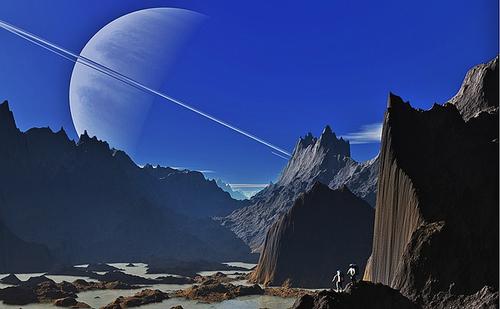
Saturn landscape


Science fiction was one of my first loves. If you'd peeked into my room pretty much any afternoon when I was in school, you would have found me sprawled across the bed with my nose in a book, and it's quite likely it would have been sci fi. I couldn't have been more than seven or eight when I began exploring Eleanor Cameron's Mushroom Planet. Then I moved on to Heinlein's and Bradbury's visions of Mars (very different places!), and the world of Asimov's Foundation trilogy. I was in high school when I devoured Stranger in a Strange Land, fell head over heals for Valentine Michael Smith, and developed my enduring fascination with polyamory.

My husband introduced me to Philip K. Dick, Stanislaw Lem and Fritz Leiber. Then we became friends with a woman who taught English at a local university. She organized a scifi reading group. What a glorious year and a half that was! Every month we'd read a new book and discuss it, over delicious potluck dinners (with a strong emphasis on the desserts). I sampled a raft of new authors: Olivia Butler, Greg Bear, Sheri S. Tepper, Pat Cadigan, Harry Harrison, James Tiptree, David Brin... I was like a kid in a candy store!

I discovered that I much preferred “soft” science fiction – stories that start with some premise about society or history and then explore the consequences. For example, The Man in the High Castle, which is the first Dick book I read, turns on the notion that the United States and its allies lost World War II. The author then proceeds to build a world in which the Japanese and the Germans have divided up the American continent, and San Francisco is mostly Asian. (Gee, sounds like the present!) Another favorite is A Canticle for Lebowitz, by Walter M. Miller, Jr. In a post-apocalyptic future, devout communities of monks act as custodians for the mysterious knowledge and artifacts of vanished civilization. One of the most sacred of all texts is written in the hand of Saint Isaac Lebowitz and begins “gallon of milk/loaf of bread/...” Then there's Kate Wilhelm's The Year of the Cloud. I don't remember where I picked this novel up – it's obscure, far less well known than her masterpiece Where Late the Sweet Birds Sang – but I remember now, decades later, how it impressed me. The earth passes through a cloud of stellar dust. The dust has the effect of “thickening” water, turning it from liquid to a kind of sludge. Having posited this single fact, Wilhelm then proceeds to show how this turns society upside down, as humans (over ninety percent H2O) die and usable water becomes increasingly scarce. I found the book chilling but totally plausible, once you had accepted the triggering event.

So when I began publishing, why didn't I write science fiction instead of erotica? Partly because I didn't dare! I doubted my ability to create a compelling yet believable alternative world. And I'd read so much science fiction by then, I felt as though all my ideas would be derivative.

Still, I've been tempted – and once or twice, I've given in. Now, after more than a dozen years as an author, I've published just two science fiction erotic romances: a M/F/M ménage novella called Bodiesof Light and my M/M novel Quarantine. As you might guess, both fall into the “soft sci fi” category, even though Bodies of Light is set on a starship hurtling toward a far galaxy.

Bodies of Light is about the non-corporeal nature of desire. Since my primary genre is erotica/erotic romance, it's natural that the sci fi themes that interest me relate to sexuality.


Physicist Dr. Christine Monroe has devoted her lonely life to research on hyper-space travel. Guilt about her continued failure leads her to sign on to the Archimedes, a sub-light-speed mission aimed at establishing a colony in the Sirius B system. When she wakes from suspended animation, she discovers that the ship is wildly off course and the rest of the crew are dead due to equipment failure. At first she thinks the two handsome strangers who show up on the ship are figments of her imagination - erotic hallucinations created by isolation and stress. However, Alyn and Zed are solid, real, and ready to sacrifice their lives for the strong woman they've found stranded in deep space. As her ship begins to disintegrate, Christine must choose between the planet she was sent to save and the two alien beings she's come to cherish.

Quarantine focuses on politics and prejudice. It takes place in a dystopian near future, when all known homosexuals (identified by a genetic marker) have been imprisoned in remote quarantine camps, ostensibly to protect the general population from the plague the gays carry. After seven years of confinement, inmate Dylan Moore will do anything for freedom, including seducing Rafe Cowell, an ex-gang member sentenced to a bleak stint as a camp guard. 


Rafe is H-negative. He figures the lust he feels watching prisoner 3218 masturbate on the surveillance cameras must be due to his loneliness and isolation. When he finally meets the young queer, however, he finds he can't resist the other man's charm. By the time Dylan asks for his help in escaping, Rafe cares too much for Dylan to refuse.

The novel follows the two men as they become fugitives, fighting murderous androids, homophobic ideologues and their own mutual distrust. Hiding in the Plague-ravaged city of Sanfran, Dylan and Rafe learn there's far more than their own safety at stake – that the lives of millions more people depend on their success in resisting the shadowy Guardians who control and manipulate what's left of American society.

I'm afraid that neither book will win a Hugo (although Bodies of Light received a Best Book award from Whipped Cream reviews). Nevertheless, I'm incredibly proud that I've finally added my own visions to the science fiction canon.

I’ve accepted that no scifi I write is going to be Philip K. Dick (though he might well have felt at home in Rafe's and Dylan's world) – but it's my attempt to honor my life long love. 

I'm giving away a copy of Bodies of Light to one person who comments on this blog post. Tell me about your favorite sci-fi title - or just say hi! Don't forget to include your email address.

Saturday, March 31, 2018

Seven Sci-fi Books that Changed Me -- #ScienceFiction #SaturdaySeven #LASR

Saturday Seven banner

From my earliest years as a reader which began when I was four—science fiction has been one of my enduring loves. The first sci-fi books I remember were The Wonderful Flight to the Mushroom Planet by Eleanor Cameron and The City Under the Back Steps by Evelyn Sibley Lampman. I doubt I was more than seven at the time, just introduced to the wonders of the library.

Of course, I grew up during the dawning space age. I was in fourth grade when Alan Shepard circled the globe in his tin can. Men landed on the moon the year I graduated high school. Indeed, I wanted to be an astronaut, until I learned that there was no way they’d take someone with my serious myopia and flat feet. (The fact that I was female never seemed to me to be an obstacle.)

Over the years, I’ve read lots of sci-fi, though to be honest, much of it has been forgettable. However, here are seven science fiction titles whose memories I cherish, books that opened new vistas for me or changed my view of the world.


The Martian Chronicles by Ray Bradbury

I’ve loved Bradbury ever since I first encountered his work. This book presents a poetic, nuanced vision of true strangeness. On a planet where man is the alien, there is much to be learned about ourselves. Beautiful, scary and intense, this book taught me that we humans weren’t the center of the universe.


Stranger in a Strange Land by Robert A. Heinlein


I read this when I was just past puberty, overwhelmed with hormones like all teens. I have to admit that what made the most lasting impression on me in this book was the sex. No, there are no explicit sex scenes in this novel. However, Valentine Michael Smith, the human brought up by Martians who is the “stranger” of the title, establishes a polyamorous tribe in which sex (“water-sharing”) is both ecstasy and sacrament, a connection of mind as well as body. I know my own views and experience of sexuality (often expressed in the stories I write) borrows a lot from the philosophy of this book.


The Man in the High Castle by Philip K. Dick

 
Hard as it might be to believe of a sci-fi afficionado, I’d never heard of Philip K. Dick until my husband introduced me to this book. (A love of science fiction is just one of many things my DH and I have in common.) I was totally floored by its audacity, its detail, the darkness of its themes and the brilliance of its exposition.

Dick paints a vivid picture of an alternative present in which the United States and its allies lost World War II. Starting from that single premise, he imagines a world in which the Nazis and the Japanese have divided the continent, then spins out the consequences.

How did this book change me? (Aside from making me a huge Philip K. Dick fan, that is!) It crystallized my awareness of what I like most about science fiction—the way one powerful idea, one modification of reality, can change everything. That’s the sort of sci-fi I usually like most, not the space operas with tons of technological marvels, or the interstellar epics with dozens of planets and civilizations. I’m interested in the social implications of technology, more than the technology itself.


Holy Fire by Bruce Sterling


This book came out in 1997, and I probably read it soon after. It’s interesting what I do and don’t remember about the novel. The heroine, Mia, is an ancient woman, over a hundred, who undergoes physical rejuvenation. What I recall most vividly is the disconnect she feels between her gerontocrat mind and her youthful body. We like to fantasize about eternal youth, but Sterling does a fantastic job portraying the complexities that would likely arise if this technology were to become available.

As I am now well on the way to being an old crone myself, I sometimes fantasize about what it would be like to have my lithe, sexy young body back. When my thoughts tend in that direction, I recall this cautionary tale.


Anathem by Neal Stephenson


I said I don’t usually prefer science fiction books that construct elaborate new worlds, with their own cultures, languages and so on. Anathem is an exception, partly because it really is a book about ideas—competing ideas about the nature of the universe, time, man, and the earth, battling for supremacy.

Stephenson has a brilliant imagination but sometimes too little discipline. I’ve tossed his books halfway through because he didn’t know when to stop going off on tangents. In this massive novel, though, he keeps himself in check, building an exquisitely detailed universe in which science, and power, are centered in monasteries scattered over the earth. As was the case in the Middle Ages, these monasteries preserve the past, but also are limited by it.

I can’t count how many times, reading this book, that I stopped, amazed, at some incredible (and often slyly humorous) notion or description. You can read Anathem as an adventure, but I think it’s a far deeper effort by intent. 
 

The Windup Girl by Paolo Bacigalupi


This novel, published in 2009, is hands-down one of the best science fiction books I’ve read—ever. Since it won both the Hugo and Nebula awards, I guess other people agree with me.

The book is set in Bangkok, in a not-so-distant future when the planet is crushed under the heel of the agro-conglomerates who control all the genetically modified food stuffs. Petroleum reserves have long since been exhausted. People use gene-edited beasts of burden and kinetic energy storage to accomplish their work. Thailand has preserved some original, non-modified seed stocks, though, and Company Man Anderson is determined to get control of this precious, subversive genetic material.

This book deeply impressed me, on a whole range of levels. The portrayal of Thai society and culture is so accurate (based on my past experience living there) that I can hardly believe the author isn’t Thai himself. The many characters are distinctive, rich, sympathetic yet highly flawed. Meanwhile, the conflicts and the environmental scenarios are all too believable.

I picked up a copy of this book at a used book sale. Since then I’ve bought it for at least half a dozen people as a gift, and recommended it to many more. Astonishing.


Quarantine by Lisabet Sarai


Wait a minute! Am I really about to include my own novel in this list?

Well, I’m talking about books that changed me. Despite my love of sci-fi, or maybe because of it, I haven’t dared write very much in this genre. Quarantine is to date my only full-length science fiction title. Writing Quarantine, a MM sci-fi romance, was one of the most difficult things I’ve ever done. The process gave me new respect for writers of sci-fi.

The book takes place in a dystopic near future. After a sexually transmitted plague kills millions and devastates society, a shadowy group steps in to restore order. The self-styled Guardians of American Greatness incarcerate all males who carry the “homogene” in remote internment camps, supposedly to protect the population from a recurrence of the plague. One of my protagonists, Dylan, has been a camp prisoner for seven years; the other, Rafe, is one of the few humans who supplement the robot guards that maintain camp security.

Rafe is H-negative. He’s not gay. Yet he falls in love with the brilliant, desperate young detainee. Together they escape to the riot-scarred city of SanFran, where they find both allies and enemies.

Throughout the process of writing this book, I worried that my world wasn’t sufficiently imaginative to hold readers’ interest. I agonized over details, struggled with back-story, lost my self-confidence. I stopped working on the book for more than six months, convinced it was worthless.

Now, though, I think it’s one of the best things I’ve written, with a lot more substance than most romance (including my own). The process taught me that sometimes, creation involves the pain of self-doubt.

Still, I’m not eager to tackle writing another science fiction novel anytime soon! I’ll just enjoy books written by others.

Anyone have any suggestions? What science fiction books have made the most impression on you? Leave me a comment to let me know, and I will enter you into a drawing for a free copy of Quarantine. (Don’t forget to include your email!)


Tuesday, July 30, 2013

Channeling the Cat

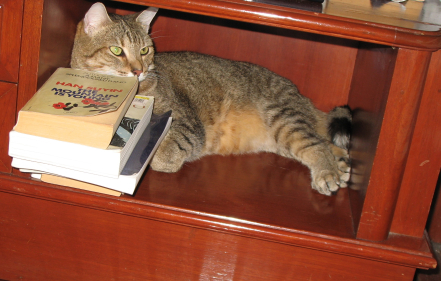
It's almost a joke – the common association between authors and cats. I haven't done a systematic survey, but I would estimate that at least 75% of the authors I hosts as blog guests mention feline companions in their bios. I'm no exception. I currently have two cats who traveled with us from the United States to southeast Asia ten years ago, and who have settled in quite comfortably. Here's a photo of polydactyl Mr. Toes as a kitten (you can see where he gets his name!).


And here's our elegant Blackness.


Of course, many famous writers (of whom I have hosted very few) were renowned for their close relationships with their felines. There's Colette.


Papa Hemingway


Jean-Paul Satre


Ray Bradbury


I sympathize with Alexander McCall Smith. Mr. Toes loves to climb around on my back, often with his oversized claws embedded in my clothing – or my flesh!


The woman who inspired my erotic writing career, Portia da Costa, is a huge cat lover – that's one of the things that forged a bond between us – but she's so shy I couldn't find a picture of her and her cats together.


Many explanations have been offered for the feline-author affinity. A cat doesn't need to be walked, so we can spend our time at our desks as opposed to trucking around on the street scooping up their business. Cats are mysterious creatures with many layers of personality – rather like effective characters. Cats have an elegance and precision of movement we writers might use as a model for our prose. Many authors have cited their felines as sources of inspiration. Noted Canadian writer Robertson Davies once said “Authors like cats because they are such quiet, lovable, wise creatures, and cats like authors for the same reason.”

The other day, I was suddenly struck by a new theory. I was thinking about the fact that so many authors report hearing “voices”. “I just listen to my characters, and write down what they say,” one of my guests commented. Writing sometimes feels like something driven from outside, beyond our conscious control. Well, what if that's true?

What if it's not our characters who are dictating the story? What if it's our cats?

Ridiculous, right? But Mr. Toes sits behind my monitor most days I'm writing. He pretends to be asleep, but if I should get up for a bathroom break or a drink of water, he stirs and gives me a look, as it to say, “Where are you going? The story's not done yet!”

I grew up with cats. I grew up writing fiction. When I went off to college and then grad school, I left the felines behind, and although I wrote lots of poetry during that period, I didn't pen a single story. Then I met my husband, a confirmed ailurophile, and filled my life with felines once more. Next thing you know, I was a published author.

Ever tried to write when your cat was sick? Tough to concentrate on the tale, isn't it?

And wouldn't this explain why our characters are larger than life? Why they have so much vitality, such powerful passions, such intense adventures? How could a mere human imagine such creatures? Cats, though – they have superhuman abilities. Just ask them.

Of course to really test this, we'd all have to get rid of our felines and then see if we could still write.

That might be informative. It might restore our self-respect. But it's simply too painful to contemplate.

If I'm channeling my cats, I'm okay with that (though they have surprisingly dirty minds). As long as they don't want their names on the cover.


Monday, December 20, 2010

Rediscovering an Old Love

Like many authors, I started reading at an early age. I read everything - mysteries, historical novels, biographies, classics - but I especially loved science fiction. I still remember how intensely I entered the world of the Mushroom Planet. As I got a bit older, I discovered Bradbury, Asimov and Heinlein. The intellectual challenge of the Foundation Trilogy kept me up at night. Stranger in a Strange Land deeply influenced my views about sex and spirituality.

In the early nineties, I belonged to a science fiction book club started by a friend. That introduced me to new voices: Sherri Tepper, Oliva Butler, James Tiptree, Kate Wilhelm. Unfortunately, those monthly read/eat/talk orgies stopped after only a year. Since then, I haven't had the opportunity to read much scifi. For one thing, I've been busy writing my own fiction.

In the last few months, though, I've rediscovered my old love, as an author as well as a reader. One of my friends and colleagues writes fabulous scifi with an erotic slant. He has inspired me to try my own hand at the genre.

I'm now working on a near-future M/M novel about gender and politics (and love, of course). I also just finished the first draft of a novella I plan to submit to an anthology called "Seeing Stars". That story, "Bodies of Light", takes place on a star ship engaged in a mission to colonize a distant planet. Hard core scifi indeed!

I'm having a wonderful time exploring my old flame. However, I've come to realize that scifi is a particularly difficult genre to create - perhaps not as hard as historical fiction, but close. The reason? In scifi, the details really count. You're creating an alternative world, but you don't have a free hand. If you want to write realistic scifi, as opposed to fantasy, your premises must be grounded in fact and your explanations need to be consistent. I found this particularly true in writing "Bodies of Light", which as a background in quantum mechanics. (But don't worry! It's much more sexy than it is technical!)

In celebration of my rekindled interest in science fiction, I've posted a story on my website, an edited version of one of my first attempts at the genre - before Lisabet Sarai existed. You can read "The Ambassadors to G79-3" here. Compared to my current work, it's rather tame, but even back then (about twenty years ago, near as I can tell) I had erotic notions.

I haven't submitted either of my scifi works yet. I feel a bit like an amateur tackling this genre, despite my decade-plus publishing history. I don't know if I'll be successful. But I'm certainly having fun!